
03.62 · Thick laminate: reaction heating, cure gradient and process stress
Level 4AdvancedEst. 40 min
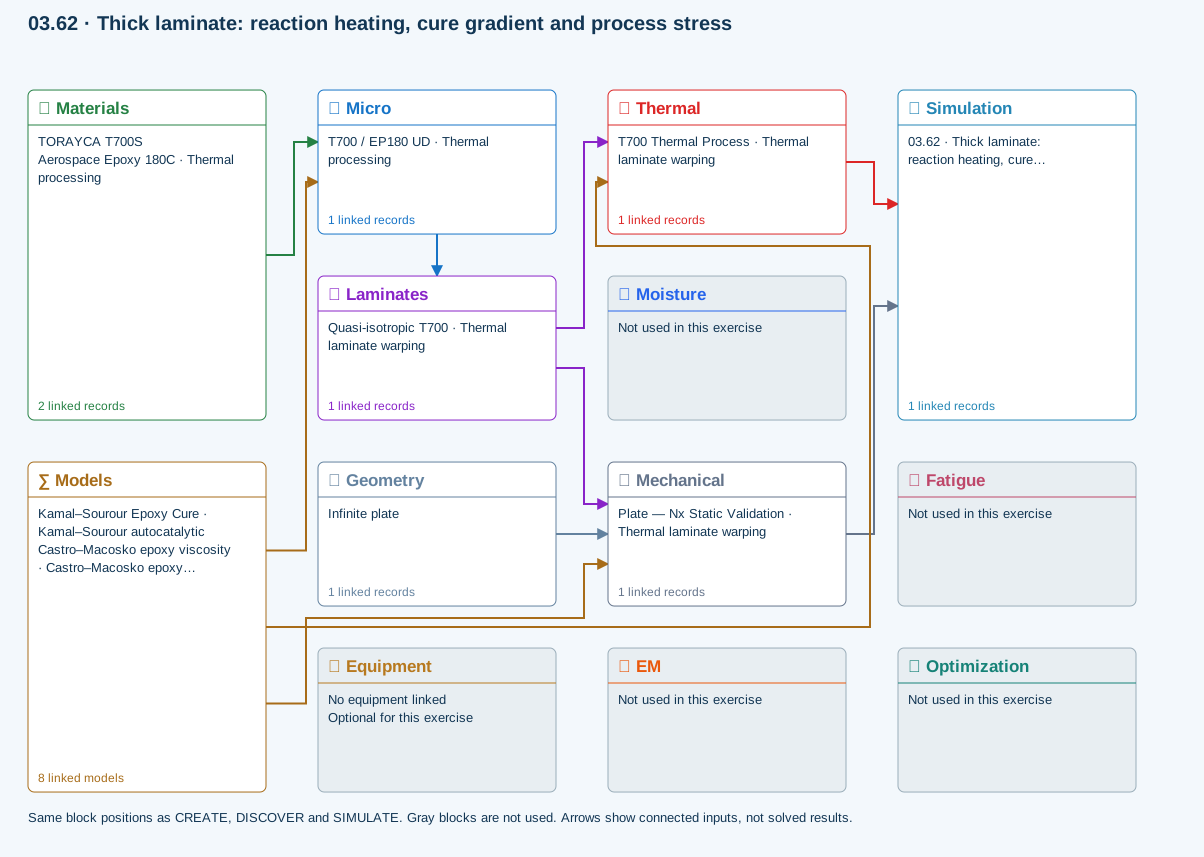
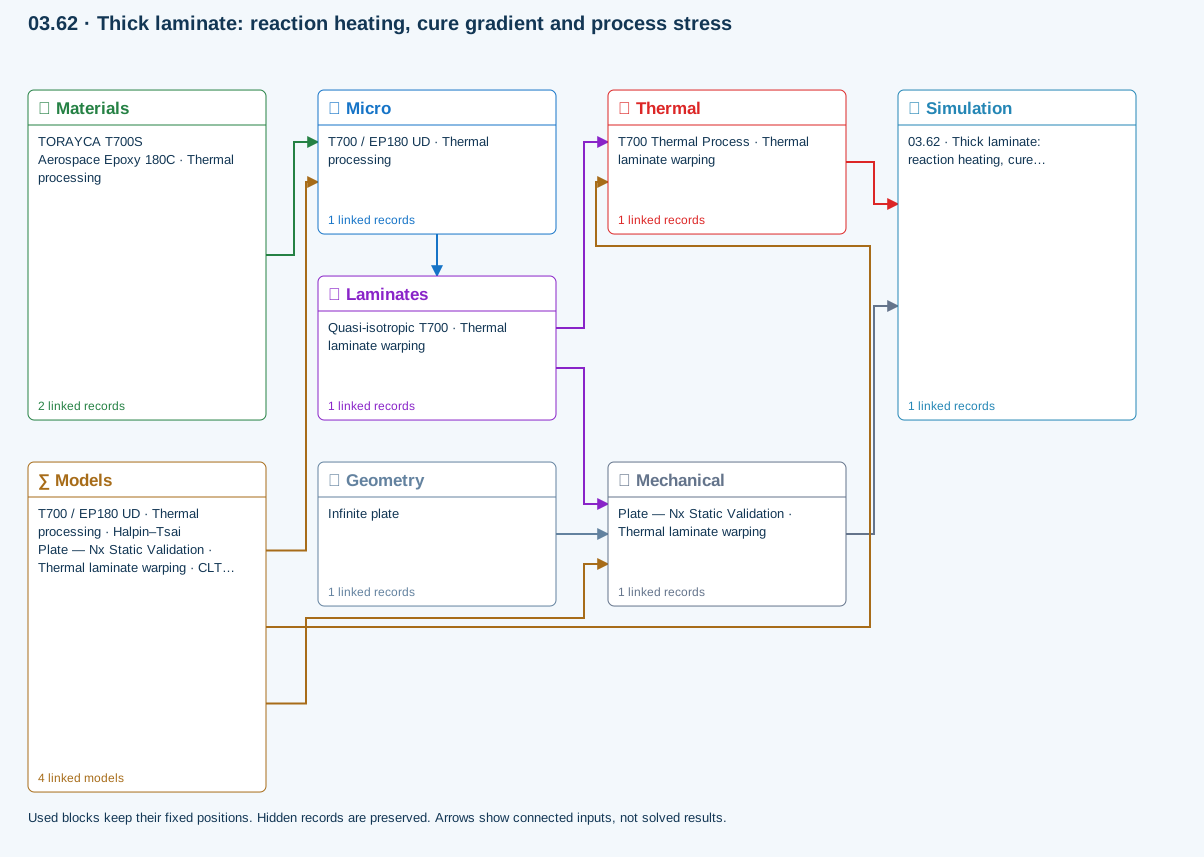
All blocks keep the CREATE / DISCOVER / SIMULATE positions, with Equipment below Geometry; unused records remain disconnected. This changes the view only, not the exercise records.
∑ Used models & submodels
Only models assigned to records used by this exercise are listed here. The full-layout option preserves the supplied starter records; no Workbench records are changed.
Halpin–Tsai · T700 / EP180 UD · Thermal processing
One compatible homogenization model per Micro recipe. Separate recipes compare models; their predictions are not blended.
∑ Theory & assumptionsCLT · Linear static with failure indices · Plate — Nx Static Validation · Thermal laminate warping
Shared laminate stiffness drives this membrane/CLT path. Failure criteria are independent comparisons, not blended models. Fatigue is a separate assessment.
∑ Theory & assumptions1D transient heat transfer · T700 Thermal Process · Thermal laminate warping
Needs linked laminate properties and a compatible process schedule. A linked cycle is not a solved temperature history.
∑ Theory & assumptionsMaximum stress · Plate — Nx Static Validation · Thermal laminate warping
Primary ply criterion for Plate — Nx Static Validation · Thermal laminate warping. Envelope comparisons are independent; criteria are not blended.
∑ Theory & assumptionsData travelling between blocks
Micro → Laminates
Predicted ply stiffness, strength, density and expansion properties.
Materials → Micro
Constituent stiffness, strength, density and thermal / moisture properties.
Mechanical → Simulation
SIMULATION selects this case and its analysis model; the case owns its applicable cycle and input references.
Laminates → Mechanical
Ply angles and thicknesses, stiffness, mass and ply properties.
Geometry → Mechanical
Part shape and dimensions, thickness or section definition, and model-specific geometric inputs. Each selected case consumes only the dimensions its model supports.
Thermal → Simulation
SIMULATION selects this case and its analysis model; the case owns its applicable cycle and input references.
Laminates → Thermal
Ply angles and thicknesses, stiffness, mass and ply properties.
Models → Micro
Applied model assignment: Halpin–Tsai. Model parameters and formulation are used by Micro.
Models → Mechanical
Applied model assignment: CLT · Linear static with failure indices. Model parameters and formulation are used by Mechanical.; Maximum stress
Models → Thermal
Applied model assignment: 1D transient heat transfer. Model parameters and formulation are used by Thermal.
Run the 6 mm laminate through the 120°C dwell with its linked resin reaction heat.
Models: Heat transfer · Classical laminate theory · Extension–bending coupling · Thermomechanical coupling
Study scope and limitations
Teaching inputs, not qualified allowables. Sequential coupling transfers the reported thermal/moisture state to laminate mechanics; it is not simultaneous 3D multiphysics. Inspect the transferred state and reference values before interpreting stress or curvature. Free laminate CLT curvature, not fixture-constrained distortion, a full tool-release simulation or calibrated cure-shrinkage prediction.
What the study needs
| Choice | Why it matters |
|---|---|
| Material and layup | Elastic properties and fiber directions determine stiffness; strengths and fracture data are needed for the selected failure models. |
| Geometry and support | Shape, dimensions and boundary conditions determine how a component deforms and carries load. |
| Mechanical loads | Specify the forces and moments, including which components increase during progressive failure. |
| Process and environment | Temperature, moisture and material state can produce expansion, shrinkage and residual stresses. |
Define the surfaces and the material state
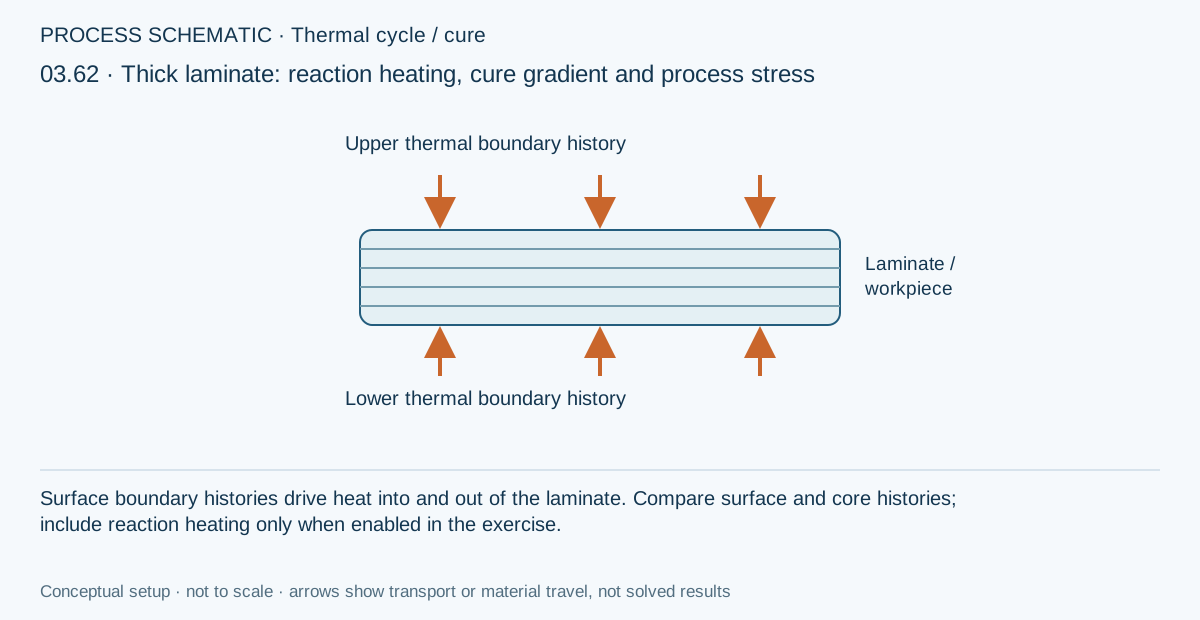
- Give the upper and lower surfaces independent histories when their surroundings differ.
- Choose prescribed temperature, convection or another supported thermal boundary condition.
- Define moisture exposure and the corresponding diffusion properties when studying uptake or drying.
- Provide calibrated cure or crystallization kinetics for reacting materials; use an inert material when no reaction is intended.
- A recorded pressure history is not, by itself, proof that pressure has been mechanically coupled. Check the selected structural loads.
Named response and traceability outputs
| Named result group | Contents |
|---|---|
| Transport histories | Transport metadata, time, temperature, and moisture |
| Material-state histories | Cure/crystallinity states, rates, heat sources, and shrinkage |
| Surface and ply summaries | Interpolated surfaces and final per-ply process summary |
| Process-to-structure results | Structural mapping, process-only field contributions, and process resultants |
| Double-Double recommendation | Compatibility, recommended angles, stiffness error, and selected ply angles |
| Structural summary | Cylinder summary plus plate/beam section, response, energy, buckling, and frequency results |
| Cylinder load history | Cylinder loads and resultants |
| Cylinder stress recovery | Final radial-coordinate and recovered-stress table |
Interpret before comparing. Check the final material state and residual stresses, then compare the loaded response. Missing transport or strength data must not be treated as a validated pass. Try the coupled exercise →