
A wave-propagation study uses layer properties, thicknesses and excitation to predict a specific electromagnetic response. This exercise helps you relate the chosen formulation to its outputs, while keeping finite-stack reflection and transmission, pulse histories and periodic-cell behaviour distinct.
Explicit dielectric teaching inputs. Mechanical laminate properties are not used in this separate RF study.
Open this exercise in Workbench
Prepare the baseline
Review the explicit electrical layer inputs and the selected frequency, incidence or time-domain settings. Run the supplied configuration first, then change one parameter supported by that formulation. Preserve the excitation and plotting conventions when comparing results, and inspect the model-specific numerical or energy checks described in its reference.
Worked procedure
1. Review the explicit electrical phase or layer properties and the frequency or excitation settings used by this EM study. Identify the conventions and assumptions stated for the selected formulation, including any geometry, fractions or layer thicknesses it requires. Do not substitute mechanical properties for missing electrical data; the model needs its own documented input basis.
2. Run the supplied study as a baseline and inspect the complete response curves, including their axes, units and parameter settings. Retain the numerical values or a clearly labelled capture before changing an input. Use the interpretation guidance below and the linked formulation to identify what each curve represents and which conclusions remain outside its scope.
3. Choose one editable parameter that belongs to this model and record its original and revised values. Keep the other inputs fixed, rerun the study, and compare the same output quantities over the same range. Explain the observed change using the linked formulation, including a discussion of whether the comparison stays within the model’s calibration and assumptions.
Review checkpoints
Do not interpret example calibration values as material allowables.
Record the assumptions and distinguish analytical verification from experimental validation.
Model limits
Lossless isotropic A/B unit-cell eigenvalues, folded Bloch phase and stop-band attenuation at normal incidence. Not arbitrary-cell homogenization. Positive-permittivity, passive, nonmagnetic RF screening only. This separate study uses explicit EM inputs, not mechanical or cure properties. Illustrative defaults are not measured T700 properties.
Interpret the comparison
Read each curve as the quantity actually calculated by that branch. A periodic-cell decay measure, a finite-stack shielding result and a reflected pulse are not interchangeable. Use the linked theory to explain the comparison, state the one-dimensional idealization and avoid claiming an automatic electromagnetic-to-thermal or mechanical transfer.
How information passes between models
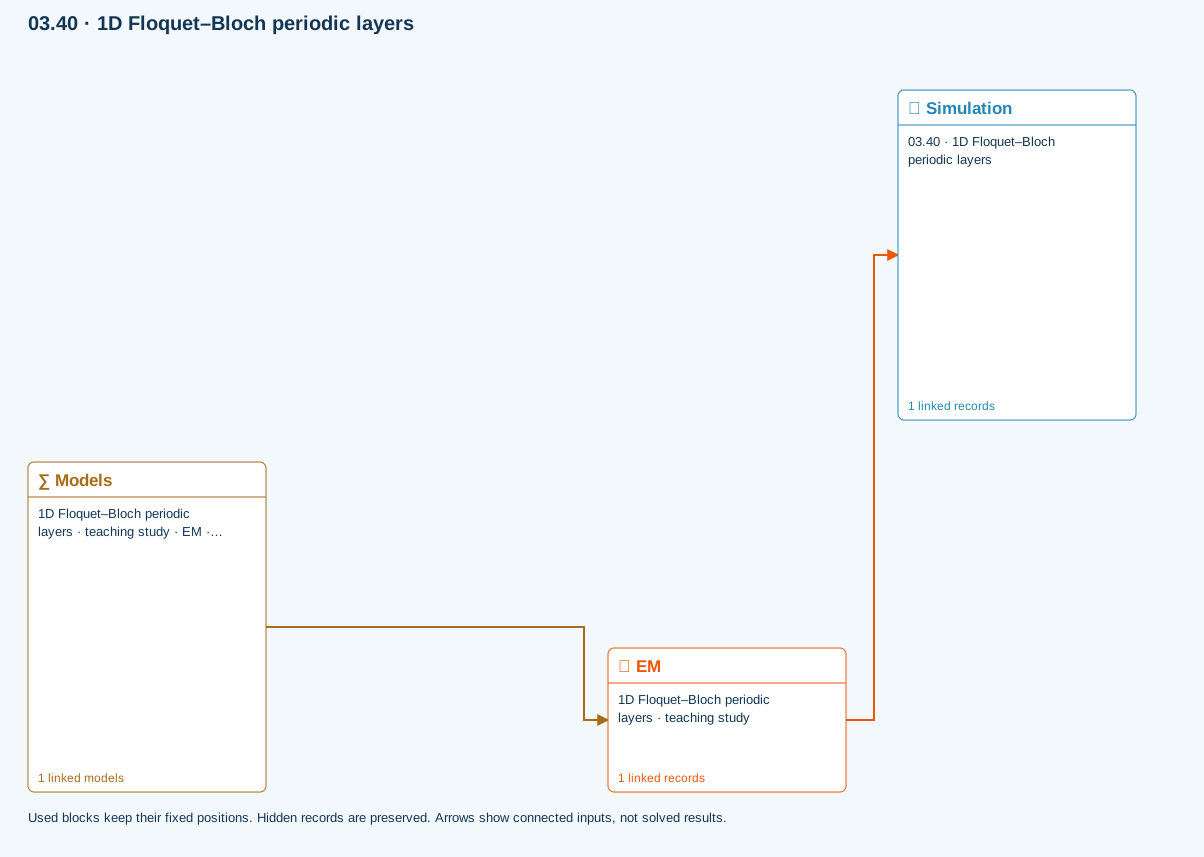
EM → Simulation: SIMULATION selects this case and its analysis model; the case owns its applicable cycle and input references.
Models → EM: Applied model assignment: EM · 1D Floquet–Bloch periodic layers. Model parameters and formulation are used by EM.
Further reading and evidence
- Advanced analytical models: equations, calibration and limits
- Edit laminate materials, angles and thicknesses
- Run and review a model
- Connected inputs and result freshness
Review the recorded validation scope. Retain the original inputs and solver notices with the results. Representative teaching data are not design allowables.
References and source sections
References are retained with the formulations they support. Software instructions describe implementation scope; a cited source does not establish independent validation of a CDS calculation.