Choose a lighter panel
Compare ply angles and stacking sequences before committing to a panel design. Follow the trade-off between directional stiffness, thickness and mass, then assess the relevant load case.
Explore laminate design →02 / Capabilities
Connect material selection, reinforcement design, layup and manufacturing decisions in one engineering study. CDS helps you explore alternatives, understand the drivers of performance and keep the assumptions behind each result visible.
ENGINEERING QUESTIONS, CONNECTED ANSWERS
Typical applications below illustrate how to build a study—not customer case histories or certified design predictions.

Compare ply angles and stacking sequences before committing to a panel design. Follow the trade-off between directional stiffness, thickness and mass, then assess the relevant load case.
Explore laminate design →
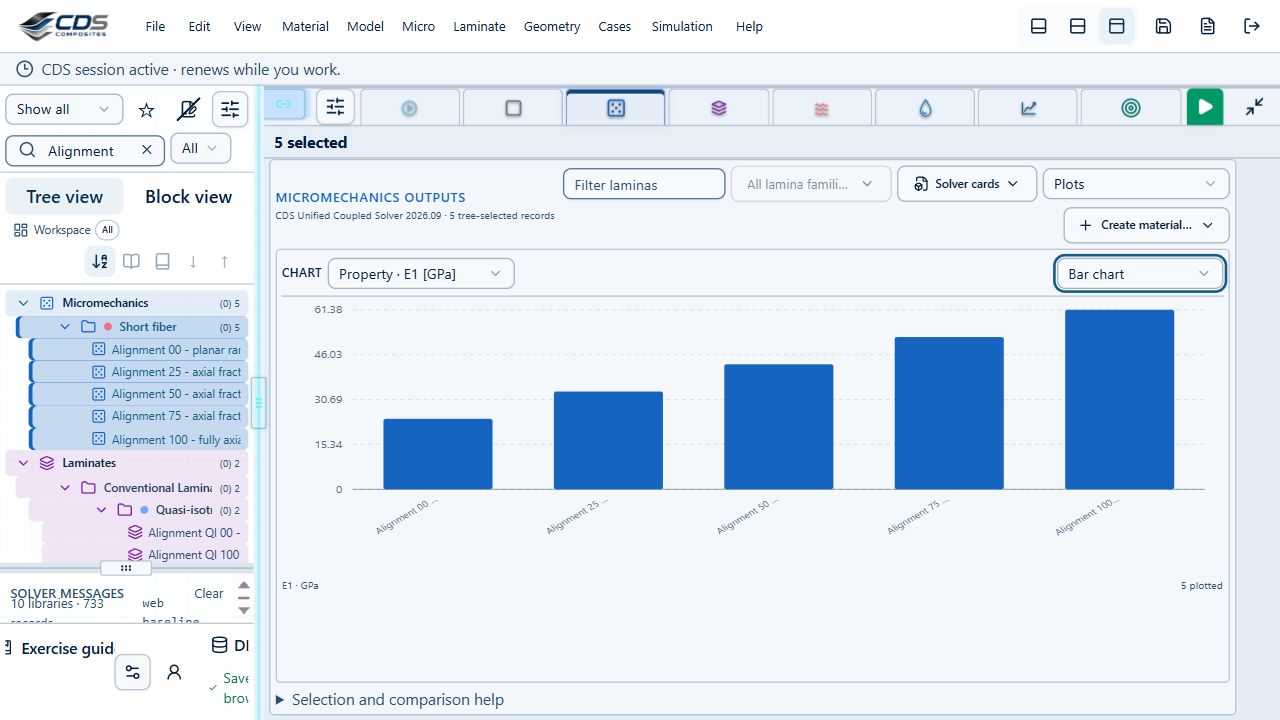
Ask how constituent choice, fiber fraction and alignment change effective ply stiffness. Carry the resulting properties into a laminate instead of treating material and layup decisions separately.
Explore micromechanics →
Connect heating zones and roller contact to the process experienced by the moving material. Compare the prescribed conditions with thermal response before deciding which process settings need closer investigation.
Explore process studies →
Look beyond a single stiffness value. Compare load directions, locate first-ply failure and inspect progressive damage in a supported formulation using explicit strength and degradation assumptions.
Explore failure assessment →Read the published working studies → · Theory: explore the models →
Explore this section
10 destinationsOperate the master tree, bulk moves, multi-count duplication, responsive tabs, local settings, loading, saving, and entity selection from one connected window.


Create source-aware material records with constituent, transport, strength, thermoset cure, thermoplastic crystallization, and editable completion data.


Generate each ply’s complete 3D elastic, strength, expansion, density, and transport definition, then optimize properties against microstructure and model inputs.


Route each ply independently, then couple ABD response, process residual stress, environmental loading, carpet maps, envelopes, laminate optimization, and progressive failure.


Solve steady-state or transient heat and moisture histories with independent surfaces, cure exotherm, evolving modulus, shrinkage, and process-cycle optimization.


Evaluate plate, cylinder, beam and joint studies, or enter the Virtual Test Lab to connect mounted composite specimens with calculated response plots.


Save optimization snapshots, compare results, automate studies, and export traceable tables and model validation data to common engineering formats.


Connect materials, micromechanics, laminates, processing, structural analysis, and design decisions in one continuous engineering path.


Published working studies with genuine CDS2026 GUI figures, model assumptions and engineering interpretation.

A growing archive of working studies, model additions and software updates.
→