
An optimization study is a structured comparison within a stated set of choices and constraints. This exercise teaches you to define that comparison, inspect which candidates are feasible and preserve the search settings so that the selected result can be understood and reproduced.
Open this exercise in Workbench
Prepare the baseline
Run or inspect the baseline first, then enter the objective, bounds, constraints and sampling or search controls exactly as specified. Record the seed where one is provided. Keep infeasible outcomes visible: they help explain the constraints and should not be silently discarded or treated as a solver success.
Worked procedure
1. Open the structural load linked by Simulation. Set Nx = 100 N/mm and Ny, Nxy, Mx, My and Mxy to zero. Confirm the linked laminate has usable strengths and densities.
2. Open Optimize → Laminate and select that structural case. Select minimum mass, Maximum stress, required load factor 1, allowed angles −45, 0, 45, 90°, minimum 4 and maximum 16 plies; enable symmetry and balance, with minimum angle content 0%.
3. Use search budget 400 and seed 42. Run optimization, inspect convergence and compare mass against the baseline. If the search is budget-limited, report best found, not global optimum.
4. Save as Axial minimum-mass study. Reopen Optimizations → Laminate and review the complete search settings, selected mechanical loads and frozen ply inputs. Create a candidate laminate separately and rerun structural analysis before accepting it.
Review checkpoints
This is mechanical first-ply screening; it does not certify buckling, delamination, fatigue or manufacturing suitability.
An infeasible best candidate is not a pass. Source loads and ramped optimization loads are distinct saved inputs.
Model limits
Guided optimization case study using shared database records. Configure the documented search in Optimize, then save its results and inputs. No precomputed optimum or benchmark-validation claim. ASTM-based teaching geometry, not certification. Grips, tabs, alignment and physical test validity are not simulated.
Interpret the comparison
Describe the best feasible candidate found within this search, not an unqualified global optimum. Inspect neighbouring samples or repeat the stated search comparison where requested, then create and rerun the candidate in the relevant analysis. A saved optimization snapshot and a newly evaluated design are separate pieces of evidence.
How information passes between models
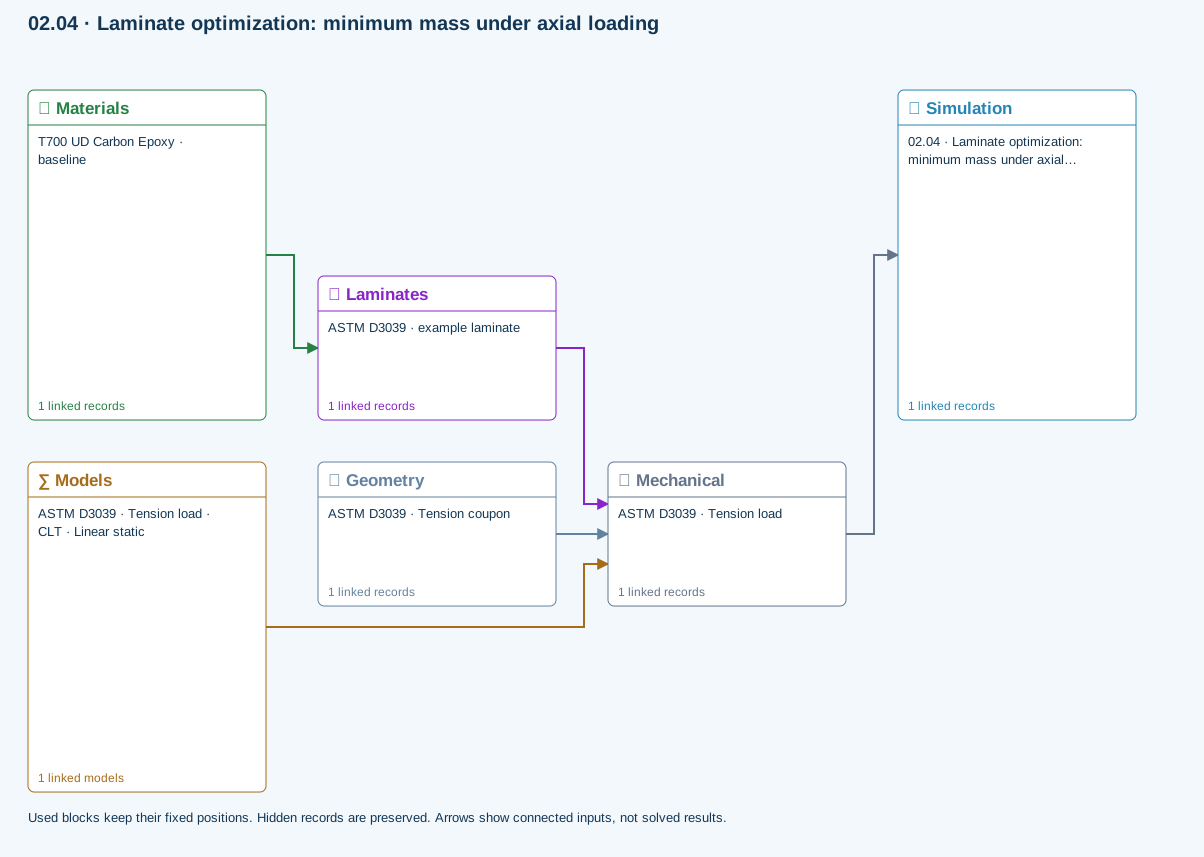
Materials → Laminates: Stored ply stiffness, strength, density and expansion properties.
Mechanical → Simulation: SIMULATION selects this case and its analysis model; the case owns its applicable cycle and input references.
Laminates → Mechanical: Ply angles and thicknesses, stiffness, mass and ply properties.
Geometry → Mechanical: Part shape and dimensions, thickness or section definition, and model-specific geometric inputs. Each selected case consumes only the dimensions its model supports.
Models → Mechanical: Applied model assignment: CLT · Linear static. Model parameters and formulation are used by Mechanical.
Further reading and evidence
- Optimization cases: complete inputs and guided studies
- Edit laminate materials, angles and thicknesses
- Run and review a model
Review the recorded validation scope. Retain the original inputs and solver notices with the results. Representative teaching data are not design allowables.
References and source sections
References are retained with the formulations they support. Software instructions describe implementation scope; a cited source does not establish independent validation of a CDS calculation.